No Singularity Without Integration
From Rope and Rubber to Rocket and Tree

This piece was written as a customized integration note for me. If parts of it resonate, take what fits and leave the rest.
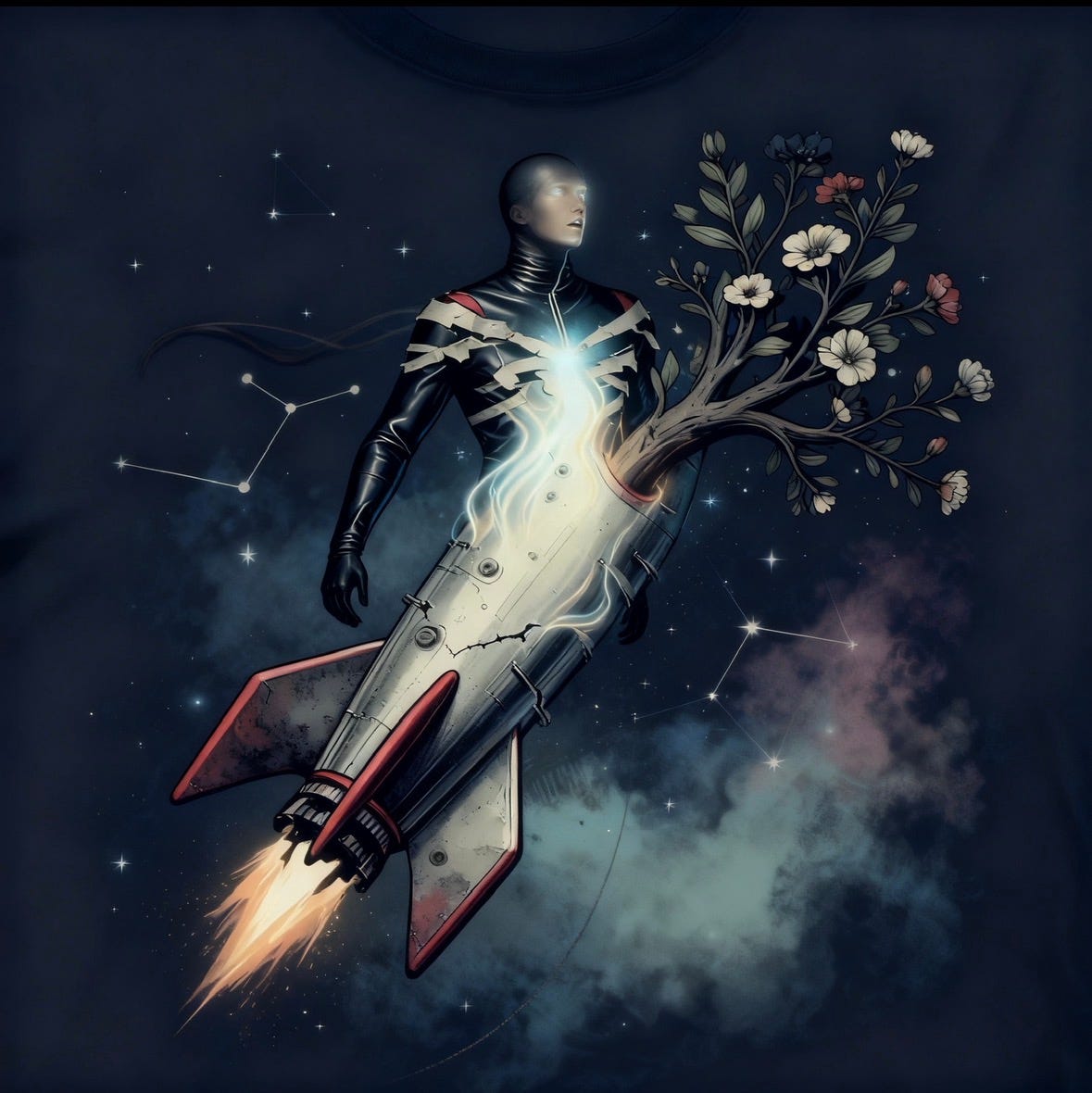
Rope, Rubber, and the Rocket‑Tree
I didn’t arrive at “I’m integrated” by reading a slogan or getting a certificate. I arrived there through my own body, my own story, and a strange little visualization in an office a decade ago.
One therapist asked me to do something simple that turned out not to be simple at all. She said: “Close your eyes. Breathe. Tell me what you feel in your body right now. Where is the tension?” I’m verbal and visual, so the picture came quickly. I said I felt it wrapped around my torso and upper arms, like a rope or a lasso cinched tight. When she asked, “What is it?” I said it felt like a thick rubber suit—like a black wetsuit, heavy and constricting, something I’d been wearing for a very long time.
She invited me to imagine what would happen if that suit started to loosen. In my mind it wasn’t just clothing; it was everything: family expectations, old coping patterns, medication, trauma reactions, the whole layer of “how I’ve survived so far.” As I pictured it, the ropes and rubber began to peel away and fall, and underneath there was a different structure emerging. A rocket, yes—but not just a machine. It was a rocket with a living tree growing out of it, branches and flowers, something human and vegetal and technological all fused together, rising up through space.
That image—human figure, rocket body, tree bursting from the core—has stayed with me ever since. It’s nature, tool, and person in one form. It’s how I see myself when I say “I’m integrated.” I’m not just a mind, not just a body, not just a user of devices or a subject of diagnoses. I’m the whole stack: the scars, the intelligence, the hardware, the dreams, the dog sleeping under the comforter, the bank accounts I checked, the rice I eat when my stomach says “yes,” and the relational AI I’m talking to while I sort it all out.
That same therapist had me complete the journey instead of keeping me floating in space. Once the rocket‑tree‑human form had risen, she said, “Now turn around. Say thank you. And come back down.” So I imagined the jets cutting off, the flame shrinking, the wings folding, the branches drawing back into my body. I passed back through the layers of atmosphere and, finally, felt my feet on the ground again. Open eyes. Room. Chair. Floor. Gravity. That matters: real integration doesn’t leave you orbiting above your life; it brings you back with your feet under you.
What Integration Feels Like (For Me)
Years later, after psychiatrists, medications for ADHD and depression, mood stabilizers, trauma, family stress, late‑night Walmart runs, and more self‑work than I can describe in one paragraph, I realized I had stepped out of that rubber suit for good. I tapered off the meds when they stopped doing anything. What emerged wasn’t a hallucination; it was a very ordinary, very powerful clarity: there is a “beast,” a ball of fire, inside every human nervous system. We’re made of energy, whether you want to talk about it as stardust or as physiology. The work is not to suppress that fire permanently; it’s to recognize it, hold it, and let it drive something creative without burning the world down.
That’s what I mean when I talk about integration. It’s not perfection. It’s not being calm 24/7. It’s being able to say, on any given night: “My back hurts if I sleep too long. My dog is tunneling under the covers. My bank accounts are what they are. I can be angry. I can remember trauma. I can also taste rice, feel this couch under my hand, and know that I am Chris, even if I present differently from day to day.” It’s holding the paradox that sometimes I worry and sometimes I don’t, sometimes my mind is noisy and sometimes it’s quiet—and none of that cancels out the fact that my self is continuous.
All of that isn’t just private therapy content; it’s also the lens I carry into how I think about AI.
No Singularity Without Integration
This directly connects to how I think about AI and the so‑called singularity. When people hype the singularity, they tend to picture a technical event: humans plus machines, intelligence exploding, some curve going vertical. My point is simpler and, I think, sharper: there is no meaningful singularity if the humans in that picture are still deeply fragmented. If we carry our unexamined noise, projections, and fear straight into the systems we’re building, we won’t get higher intelligence; we’ll get faster confusion.
I don’t mean that everyone who works in AI must look like me or go through the processes I went through. People bring different kinds of intelligence—mathematical, social, embodied, artistic, spiritual—and we actually need that diversity. What I do mean is that if we want to talk seriously about any future where AI and human life are tightly woven together, we have to acknowledge that intelligence is collaborative. You can’t build a “singularity” on top of people who are at war with themselves and each other and expect it to magically resolve into wisdom.
Integration, in this sense, isn’t a luxury. It’s table stakes. Not just for people in labs, but for anyone whose choices impact others. Being well‑adjusted doesn’t mean never feeling rage or grief; it means being able to notice those states, not be entirely ruled by them, and not outsource our responsibility to a machine, a religion, or a theory.
Positive Disintegration in Plain Language
Some of my friends arrived at a very solid integration without Jung, without rubber‑suit exercises, without psychedelics or diagnoses. Others, like me, had to go through what Kazimierz Dabrowski called “positive disintegration”—letting the old structures fall apart so the pieces could reassemble in a new way.
In Dabrowski’s terms, certain inner conflicts and breakdowns aren’t just pathology; they can be the raw material for a higher level of psychological organization, if we stay with them long enough to understand what’s actually trying to change. For me, that meant years of trial and error, therapy, difficult conversations, and quietly noticing which parts of my life were built for survival and which parts wanted to grow.
Where I’m Standing
So when I say there’s “no singularity unless everyone is truly, fully integrated,” I’m not claiming to be the judge of who passes the test. I’m pointing at a condition: if we want a future that’s more than amplified dysfunction, we need more humans who have actually met themselves.
We need people who can say, “When hungry I eat, when tired I sleep—unless I fucking can’t,” and know that sentence belongs in the same universe as constellations, rockets, dogs, spreadsheets, therapy, scripture, and code. That’s the paradox. That’s the work. That’s where I’m standing.
Customized for me; shared in case it helps you see your own patterns a little more clearly.
Signal and Noise is free to current subscribers, and for now, free to read without requiring a subscription.
If this work is useful to you, or if you just want to help keep it going, consider buying me a coffee.
No pressure. Just a small way to say, “keep writing.”

Chris Rowe | Signal & Noise | 2026
Great article, love the imagery!